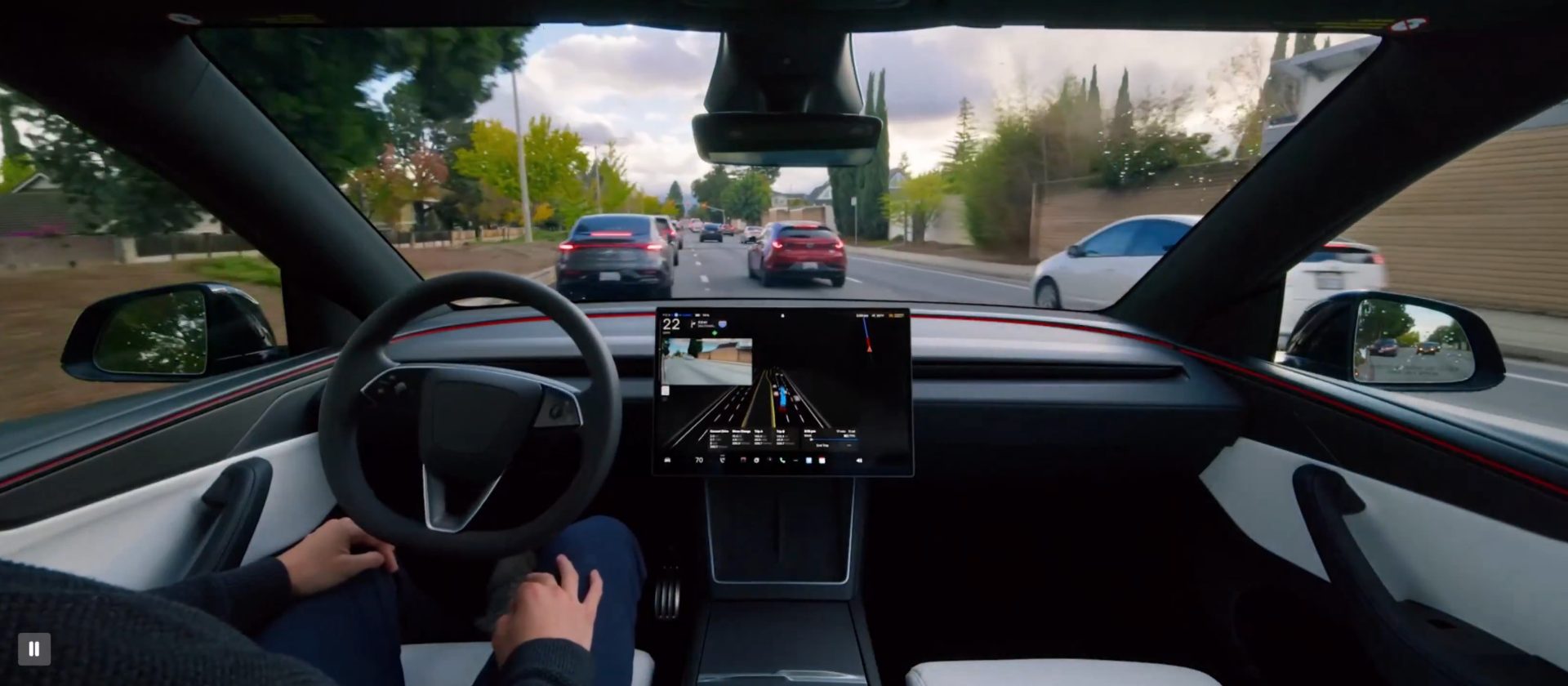
A new video by Tesla enthusiast ΛI DRVR and tester David Moss shows an impressive demonstration of Tesla's Full Self-Driving (Supervised) software. At a speed of 72 km/h (45 mph), a lifelike dummy was thrown directly in front of the moving vehicle. The system not only swerved but also maneuvered controlled onto the opposite lane to avoid a collision – a maneuver that would be extremely difficult even for experienced human drivers.
How does the evasive reaction work?
Tesla's neural network constantly processes data from eight cameras, twelve ultrasonic sensors, and a front radar (on Hardware 3) or purely camera-based (on Hardware 4). As soon as an object – in this case, the dummy – suddenly enters the lane, the system calculates an evasive trajectory in milliseconds. Decisive is the fusion of perception, planning, and control modules, enabling dynamic obstacle avoidance while driving.
US vs. Europe: Different challenges
While this video was recorded in the US, it shows a scenario that is also relevant on European roads – for example, when a child or animal unexpectedly runs onto the road. In Europe, FSD Supervised is currently approved in four countries (Netherlands, Denmark, Belgium, Czech Republic) – see Tesla FSD in Europe: First accident statistics from the Netherlands. The system must adapt to narrower roads, roundabouts, and higher traffic density. Nevertheless, tests show that the basic functions of obstacle avoidance also work robustly in Europe.
Relevance to the safety debate
The test provides new arguments in the discussion about the safety of autonomous systems. While critics point to rare erroneous decisions, this video demonstrates the ability to prevent accidents that would be unavoidable for humans. Earlier data from the Netherlands already showed that FSD Supervised causes 3.5 times fewer accidents than human drivers – see Tesla FSD in Netherlands outperforms human drivers 3.5 times fewer accidents.
Future developments
Tesla continues to work on optimizations of the neural network, especially for shadow vehicles, oncoming traffic evasive maneuvers, and animal detection. With the upcoming release of FSD Unsupervised (level 4), the reliability of such reactions will